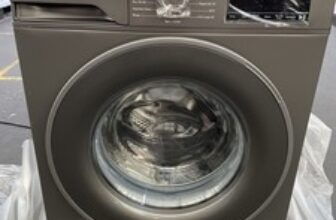
A washer can fit the gap and still leave the cupboard door with nowhere to go.
If an existing kitchen door must hide the replacement washer, fully integrated is usually the relevant design: the furniture door attaches to the machine. Built-under means the washer fits beneath a worktop; it does not, by itself, mean a furniture door can be fitted.
Check the exact model’s manufacturer door-fitting instructions first, rather than relying on a retailer’s label. The drawings should show whether a door can be attached, where its hinges sit and the permitted door size and weight. Worktop height, depth and plinth clearance matter too. For a used or refurbished machine, check that the required hinge fittings are included; compare the stated condition, warranty, delivery arrangements and returns terms before deciding whether it is a practical replacement.
Fitting beneath a worktop is not the same as hiding behind a door
- Built-under
Describes a machine designed to sit beneath a worktop. It does not, by itself, mean a matching kitchen door can be fitted to the front.
- Fully integrated
Designed to sit behind a furniture door, with fixings specified for that door. The appliance and its controls are concealed when the door is shut.
- Freestanding beneath a worktop
Some freestanding machines fit under a worktop if the opening and installation instructions permit it. Their visible front does not become door-compatible simply because it fits the space.
- Door fittings
Hinge positions and mounting hardware determine whether a furniture door can attach. They must match the exact appliance model, not just the width of the opening.
Listings sometimes use “built-in”, “built-under” and “integrated” inconsistently. For the exact model and variant, the manufacturer’s installation guide is the deciding source: check that it specifies a furniture door, its fixing method and permitted door dimensions. Also check the required space for hoses, ventilation and the plinth. A machine can fit beneath a worktop yet leave no provision—or clearance—for a cabinet door.
What changes behind the door?
A fully integrated washing machine is designed to take a matching furniture door. Built-under means it fits beneath a worktop; it does not, by itself, confirm that a door can be fitted.
| Feature | Built-under | Fully integrated |
|---|---|---|
| Visible front | The appliance front is usually visible. Check the exact design. | A furniture door conceals the appliance when closed. |
| Furniture door | Do not assume one can be fitted; check the model instructions. | Designed for one, but the door itself may be supplied separately. |
| Hinges | Door fittings are model-dependent. | Check hinge positions, fixing kit and permitted door weight against the installation guide. |
| Controls | Often accessible on the exposed front; placement varies. | Access may require opening the furniture door; check the control layout. |
| Installation | Check worktop height, depth, hoses and ventilation requirements. | Check those dimensions plus door size, hinge clearances and opening space. |
For an existing kitchen door, hinge-hole positions and door dimensions matter as much as the machine’s width. The manufacturer’s installation drawing is the useful reference: it shows whether the door can be mounted, where it attaches and how much clearance it needs to open.
Check the door fittings, not just its width
A furniture door can be the right width and still be unsuitable for an integrated washing machine. The model’s manufacturer fitting diagram is the reference for the permitted panel height, width, thickness and weight. A door that is too heavy, for example, may exceed the rating of the supplied hinges even if it covers the opening neatly.
Check these details before assuming an existing door can be reused:
- Hinge side and fixing points: Confirm which side the furniture door must open from and where the mounting holes belong. Integrated machines commonly use appliance-specific hinges and brackets fixed to the machine, rather than the cabinet hinges used on a standard kitchen cupboard.
- Handle position: Check whether the handle and its fixings clear adjacent doors, drawers and the worktop edge throughout the swing.
- Opening clearance: Allow for the door’s full swing, nearby cabinets and the space needed to open the washing machine’s own door. Check the diagram for any specified gaps at the sides, floor and plinth.
The fitting template may also show whether hinges can be fitted on either side. Reversible should not be assumed from a photograph or a retailer’s description; the installation instructions must confirm it for the exact model. For a replacement appliance, compare the old door’s dimensions and existing drilled holes with the new template rather than assuming they line up. The related guide to whether an existing kitchen door will fit covers that comparison in more detail.
A matching door width does not confirm that its weight, hinges or pre-drilled holes are compatible. Check the manufacturer’s diagram for the exact appliance model.
Measure the space the machine will actually use
A machine fits only if its installed dimensions work within the niche—not just its advertised height, width and depth. Start by measuring the space for an integrated washing machine at several points: cupboards, floors and worktops may not be perfectly level or square.
- Height: Measure from the finished floor to the underside of the worktop, including any low points. Check the manufacturer’s permitted height range and whether adjustable feet can be set without losing the clearance needed for fitting.
- Width: Measure between the cabinet sides at the front and back. Allow for the side clearances specified in the installation instructions; a nominally narrower machine may still need room to be positioned and levelled.
- Depth: Measure from the front edge of the available recess to the wall or any obstruction. Check the installation diagram for space behind the machine for hoses, the water connection, drain hose and plug. A projecting socket or sharply bent hose can reduce usable depth.
A quoted appliance depth may exclude protruding controls, pipework or the furniture door. Compare the manufacturer’s installation diagram with the actual recess, including the route to nearby connections. Also check that the furniture door can swing open without striking an adjacent cabinet, wall or handle. If the diagram does not specify a needed clearance, confirm it with the manufacturer rather than assuming the machine will sit flush.
Small installation details that can block the door
A machine can fit the measured opening yet still prevent the furniture door from closing. The installation drawing for the exact model matters more than its headline height, width and depth.
- Plinth recess: The kickboard may need to sit back so the furniture door clears it as it opens. Check the specified recess and any required cut-out against the cabinet layout. The kickboard and plinth clearance can matter even when the machine itself fits beneath the worktop.
- Adjustable feet: Levelling changes the machine’s installed height and its position relative to door fixings. Confirm the permitted adjustment range and whether the feet remain accessible once the machine is in place.
- Airflow and connections: Follow the manufacturer’s ventilation instructions, including any openings that must remain clear. Allow the specified space for hoses, cable and plugs without trapping them behind the machine or obstructing the door.
Check whether the water supply, waste connection and electrical outlet can be reached for servicing without dismantling fixed cabinetry. A plausible fit on paper is not a workable installation if connections become inaccessible or the door cannot complete its swing.
Compare the exact model’s installation diagram with the cabinet, plinth and connection positions. Required recesses, ventilation and access arrangements vary by machine; a generic clearance figure is not a substitute.
Replacing a machine or adding a door
A concealed replacement can keep the existing kitchen door only if the new machine’s installation instructions confirm that its fittings, door dimensions and clearances are compatible. Matching the old machine’s width is not enough.
Establish what must stay unchanged before comparing models: the drilled furniture door, the surrounding cabinets or the appliance’s position beneath the worktop. Each constraint narrows the options.
- Replacing a concealed machine: Compare the exact new model’s hinge positions, fixing template and permitted door weight with the existing door. Even a newer generation from the same manufacturer may use different fixing points. If the holes do not align, a replacement door or cabinet work may be needed.
- Switching from a visible-front machine: Check whether the proposed replacement explicitly accepts a furniture door. A machine that fits under the worktop does not necessarily provide door hinges or fixing points; the cabinet door, fittings and opening clearance must also be accounted for.
- Fitting a particular kitchen system: Measure the actual opening, door and plinth rather than relying on a cabinet range name. For example, integrated washing machines in IKEA METOD kitchens require checks against both the kitchen layout and the appliance’s fitting diagram.
Compare those measurements with the manufacturer’s instructions for the exact model and variant before treating an existing door as reusable.
Confirm the model and the full cost
-
Match the installation documents
A listing is not enough to establish door compatibility. Check the manufacturer’s product specification and installation instructions for the exact model, generation and variant; the fitting diagram should show the furniture-door fixings and required clearances.
Look forA matching model code and manufacturer fitting diagramAvoidRelying on a retailer’s “built-under” or “integrated” label alone -
Check what is being sold
Search results can mix complete washing machines with replacement doors, hinges and other parts. Confirm the listing’s model code, capacity and contents before comparing it with another appliance.
Look forA complete appliance with a matching specificationAvoidTreating a door or fitting kit as a machine offer -
Compare like-for-like offers
Changing availability and delivered prices belong in Content Egg offer blocks, with new, used and refurbished machines kept separate. Check what delivery and installation include, particularly where access or packaging affects the service.
Look forCondition, delivery scope and total delivered costAvoidComparing a collection-only price with delivered offers -
Read the after-sales terms
Warranty cover and returns can differ by seller and condition. Check who provides the warranty, its duration, and the process for reporting damage or arranging a return.
Look forClear seller-specific warranty and returns termsAvoidAssuming refurbished and new machines have identical cover
If no verified offer appears, the model may simply be unavailable from the retailers checked. Confirm its status through manufacturer information rather than inferring it from an empty offer block.
If the machine must disappear behind a kitchen door, built-under is not enough: the exact model must be designed to accept a furniture door. The existing panel, hinge positions and fixings must match, with enough space for the installed machine, connections, door swing and plinth. Where any fitting detail remains uncertain, the manufacturer’s installation document and the retailer’s exact-model listing need checking before an offer can be treated as compatible. If concealment is unnecessary, a built-under model may suit the space without furniture-door fittings.
For a model-specific example, see the Bosch WIW28502GB support page and its installation instructions. The drawings show how the furniture door is mounted. Use the instructions for the exact model you intend to buy.
Research-based guidance prepared with automated assistance. How our comparisons and editorial checks work.